close
close






A field supervisor at a wellsite forty minutes outside Calgary tries to pull up production data on a tablet and gets a spinning wheel instead. Dispatch can’t reach the pumper. The SCADA feed that’s supposed to alert head office to a pressure anomaly has been silently dropping data points for six hours because a cellular router failed over to a backup connection that was never actually tested. Nobody in Calgary knows there’s a problem until someone drives out to check.
This is the daily reality for energy service companies operating across Calgary and the surrounding basin, and generic IT support can’t solve it. Office-based managed IT, built around a single building with one internet connection and a predictable Wi-Fi footprint, doesn’t map onto a business where half the workforce is offsite, half the infrastructure is unmanned, and a dropped connection can mean a missed safety alert instead of a slow email. IT services for energy service companies in Calgary have to be built around field sites, remote access, and uptime as the starting point, not as an afterthought bolted onto a standard managed services package.
The Distance Between Head Office and the Field Site Is Where Energy IT Breaks
Most IT problems in the energy services sector don’t happen at head office. They happen in the gap between head office and the field, where the assumptions built into standard business IT stop applying.
A drilling contractor, a wireline company, or an oilfield services provider based in Calgary typically runs a hub-and-spoke model: a corporate office for accounting, dispatch, and engineering, a yard for equipment and staging, and a rotating set of active well sites, compressor stations, and lease roads that may only exist for weeks or months at a time. Each location has different connectivity, power reliability, and physical security, but the business expects the same access to ERP systems, safety documentation, and production data everywhere.
Standard MSPs solve for the office. They set up a firewall, a switch, a few access points, and call it done. That approach fails the moment a company needs a field site online in 48 hours, needs that connection to fail over automatically when the primary link drops, and needs someone monitoring it who isn’t three days away from the nearest truck.
A VPN Built for a Downtown Office Isn’t Built for a Wellsite
Remote access is where the gap shows up first. A traditional VPN, the kind configured for a handful of office staff working from home, assumes a stable internet connection, a managed laptop, and a user who’s reachable if something breaks. None of those assumptions hold at a remote pad site.
Field connectivity in Alberta’s oil and gas regions runs on a patchwork of cellular, fixed wireless, and increasingly satellite links, because traditional fibre and microwave infrastructure is expensive and slow to deploy in low-density areas. The Government of Alberta has committed roughly $390 million toward closing that gap through the Alberta Broadband Fund, targeting the federal benchmark of 50 Mbps download and 10 Mbps upload for rural, remote, and Indigenous communities that don’t currently have it. That investment is real progress, but it’s a multi-year build-out, not something an energy service company can wait on to get a rig or a compressor site talking to head office next month.
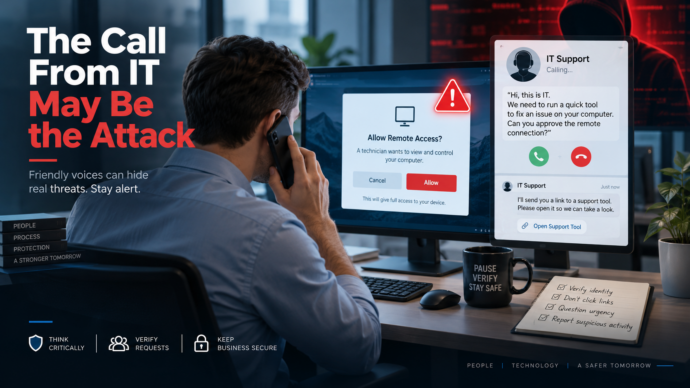
Until that infrastructure catches up everywhere it’s needed, the practical fix is architecture, not patience: SD-WAN that aggregates cellular, satellite, and wired connections into one managed link with automatic failover, so a dropped primary connection shifts to backup without a technician driving out to reset a router. VPN access built for intermittent, low-bandwidth conditions rather than office broadband. Field devices that are provisioned, monitored, and locked down the same way a laptop in the Calgary office would be, because a tablet in a truck is just as capable of becoming an entry point as a desktop at head office. This is also where a solid network security foundation matters most, since every remote connection point is a potential weak spot if it isn’t configured and monitored consistently.
OT and IT Convergence Has Made Field Devices a Security Problem, Not Just a Connectivity One
The push to connect field equipment to central systems, the SCADA units, automated tank gauges, and remote terminal units that make real-time production monitoring possible, has also made those devices a target. Canada’s Centre for Cyber Security and the RCMP confirmed in late 2025 that hacktivist groups had been actively tampering with internet-exposed industrial control systems at Canadian critical infrastructure sites, including an oil and gas company where an automated tank gauge was manipulated to trigger false alarms. The advisory noted that these weren’t targeted attacks against specific companies. They were opportunistic hits on any device left reachable from the open internet without proper segmentation or authentication.
That’s the risk profile energy service companies are now managing: a business where the same network carries payroll and email alongside SCADA telemetry and remote-controlled field equipment, and where a compromise in one direction can cascade into the other. Treating OT and IT as separate problems, or worse, not treating OT as a security concern at all because it’s “just a sensor at a wellsite,” is exactly the gap that recent advisories are warning about.
This is also where cybersecurity and field IT stop being separate conversations. Network segmentation between corporate systems and field-connected OT, monitored remote access instead of flat VPN tunnels, and visibility into what’s actually exposed at each site are baseline requirements now, not upgrades. Pure IT’s cybersecurity services are built around exactly this kind of distributed, field-connected environment, because a Calgary energy service company’s real attack surface extends well past its head office walls.
Calgary’s Energy Services Sector Runs Through Foothills and Greenview Industrial
A large share of Calgary’s oilfield services, equipment rental, and industrial logistics companies operate out of two specific pockets of the city: Foothills Industrial and Greenview Industrial. These aren’t incidental locations. They’re where the yards, shops, and dispatch offices sit that coordinate everything happening at the actual field sites, which makes them the operational hub for a business model that’s inherently distributed.
An energy service company headquartered in Foothills or Greenview Industrial has the same core problem as one operating out of downtown: the office needs to stay connected to crews, equipment, and job sites that could be anywhere from Brooks to Grande Prairie on a given week. That means the IT setup at the yard has to handle heavier network demands than a typical office, from GPS and telematics data streaming in from field equipment to video from site cameras to VoIP systems coordinating dispatch, while also serving as the secure point of entry for remote and field-based staff logging into core systems.
Uptime Is the Business, Not a Metric Measuring It
For most Calgary businesses, downtime is an inconvenience. For an energy service company, downtime at the wrong moment means a missed pressure alert, a stalled crew, or a compliance gap that shows up in an audit. Alberta’s drilling and service rig sector isn’t slowing down either. The Canadian Association of Energy Contractors projects 5,709 wells drilled across Canada in 2026, a 2.9 percent increase over 2025, supporting roughly 85,000 direct and indirect jobs tied to drilling and service rig activity. More active sites means more field connections, more remote endpoints, and more pressure on IT infrastructure that was likely sized for a smaller, slower operation a few years ago.
An IT provider serving this sector needs uptime commitments and monitoring built around field conditions, not office hours. That means 24/7 monitoring that catches a failing connection before a crew notices it, redundant links at sites where downtime has safety implications, and a support team that understands the difference between a helpdesk ticket and a call from a supervisor standing at a wellsite with no signal and a shift waiting on instructions. Reliable data backup and disaster recovery also matters more here than in most industries, since a lost SCADA log or production record can carry regulatory weight, not just operational inconvenience.
What Field-Ready IT Actually Looks Like
For a Calgary energy service company, the practical checklist looks like this: SD-WAN with automatic failover across cellular, satellite, and wired connections at every field-facing location; remote access built for intermittent bandwidth rather than assuming a stable office connection; device management that covers field tablets and laptops with the same rigor as head office desktops; network segmentation between corporate IT and any connected OT or SCADA systems; and monitoring and support that treats a field site outage with the same urgency as a head office one, because for this industry, it often carries more risk.
This is the specific gap Pure IT works in for Calgary’s energy service companies, and it’s a different discipline from standard office IT support. For a closer look at how this fits into a broader managed services approach, see our Calgary IT services page, or reach out directly to talk through what your field site and remote access setup actually needs to look like.