close
close






The End of the “Digital Perimeter”: Why Your Entire Business Needs Zero Trust
In the early days of corporate networking, security was often compared to a castle: once you cleared the drawbridge and passed the guards at the gate, you were free to roam the halls. But today, that “castle” has been replaced by a sprawling, borderless ecosystem of remote offices, cloud applications, and personal devices.
The old security mantra of “trust, but verify” is no longer enough. In an era where identity is the new perimeter, we must shift our mindset to a more resilient framework: Zero Trust.
Zero Trust isn’t just a buzzword, a single piece of software, or an initiative that belongs solely to the IT department; it is a fundamental shift in philosophy that must be embraced across your entire organization.
The “Never Trust, Always Verify” Principle
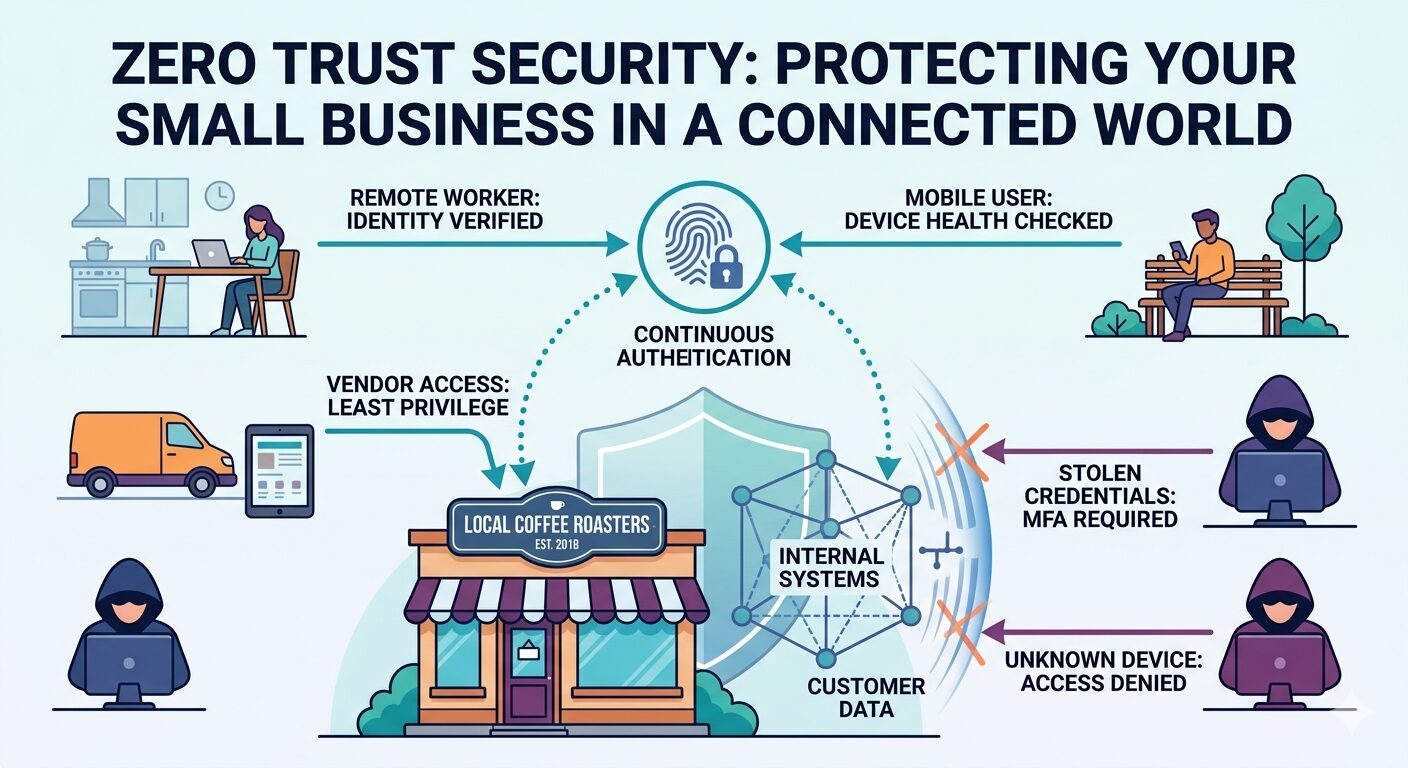
At its core, Zero Trust operates on a simple, yet powerful principle: never trust, always verify. Whether a connection request comes from inside the corporate headquarters or a coffee shop halfway across the world, every user, device, and application must be continuously authenticated and authorized.
In the past, organizations relied heavily on VPNs and firewalls. If an attacker managed to steal an employee’s credentials, they were granted the keys to the kingdom, allowing them to move laterally across the network undetected. Zero Trust assumes that a breach is inevitable—or has already occurred—and builds defenses around individual assets rather than the network perimeter.
Why Zero Trust Must Span the Entire Business
A common misconception is that Zero Trust is strictly an IT or cybersecurity project. In reality, implementing Zero Trust requires buy-in, collaboration, and adaptation from every single department:
- Human Resources: Secure onboarding and offboarding are critical. HR must work seamlessly with IT to ensure access is granted exactly when needed and revoked the minute an employee or contractor departs.
- Finance & Legal: Handling highly sensitive data requires strict access controls. Zero Trust ensures that only authorized personnel using verified, secure devices can access payroll, banking systems, or confidential contracts.
- External Partners & Vendors: Third-party breaches are a leading cause of data loss. Zero Trust ensures contractors only have access to the specific applications they need to do their jobs, heavily minimizing third-party risk.
Key Pillars of a Zero Trust Implementation
Implementing this framework across your business involves several crucial steps:
- Continuous Authentication: Moving beyond simple passwords to require robust Multi-Factor Authentication (MFA) and continuous behavioral monitoring throughout a user’s session.
- Least Privilege Access: Users are only given the absolute minimum level of access required to perform their specific job functions—nothing more.
- Device Health Verification: It’s not just about who is logging in, but what they are using. Unpatched or compromised devices are automatically blocked from accessing corporate resources, even if the user provides the correct password.
- Micro-segmentation: Breaking the corporate network down into smaller, isolated segments. If malware enters one segment, it cannot easily spread to the rest of your business.
The Business Value of Zero Trust
Transitioning to a Zero Trust architecture provides benefits far beyond just stopping hackers. It enables secure remote work by giving employees frictionless access to cloud apps without relying on clunky, slow legacy VPNs. It simplifies compliance with strict data privacy regulations by providing granular visibility into exactly who is accessing what data. Most importantly, if a breach does occur, it drastically reduces the blast radius of the cyberattack.
The digital landscape has changed permanently. The traditional perimeter is dead, and the era of implicit trust is over. It’s time our security strategies evolved. Embarking on the Zero Trust journey today isn’t just about protecting your data; it’s about future-proofing the way your entire business operates.